
Get the plugin

Labels

Label Format
– the format which the label will be generated in. Available label formats:
- PDF,
- GIF,
- ZPL,
- SPL,
- EPL2.
Creating Shipments
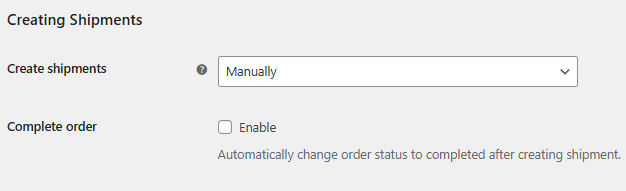
Create shipments
Choose to create shipments manually or automatically based on the order status. If Automatically status has been chosen, the metabox will be created automatically based on status, and you don’t need to click “Add shipping” to create it.
For shipments entering the EU from outside the EU, automatic label creation also requires complete customs data and valid sender and receiver types. If Default receiver type is set to Select in each shipment, select the receiver type in the shipment before automatic creation is triggered. Missing required data prevents the label from being created. To use automatic creation without this manual step, choose an appropriate default receiver type and complete the required product data.
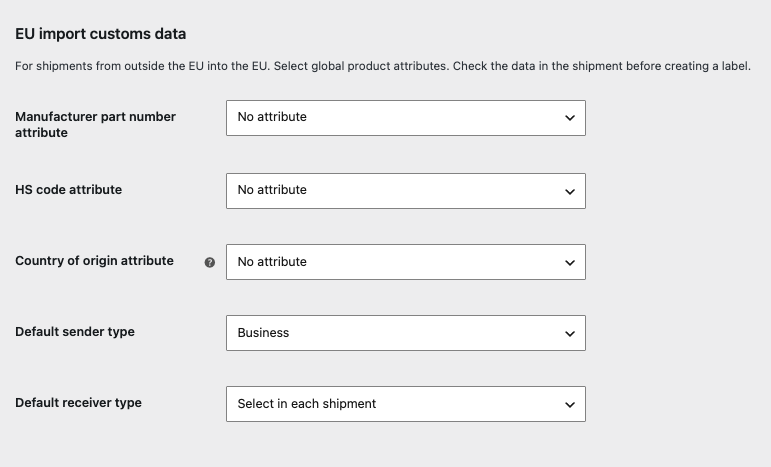
Manufacturer part number attribute – choose between no attribute, color, country of origin, detailed content, size, tariff number
HS code attribute – choose between no attribute, color, country of origin, detailed content, size, tariff number
Country of origin attribute – choose between no attribute, color, country of origin, detailed content, size, tariff number
Default sender type – choose between Business and Private individual
Default receiver type – choose between Select in each shipment, business, or private individual
Complete order
Tick this checkbox if you would like to change the order status to be completed after creating shipment.
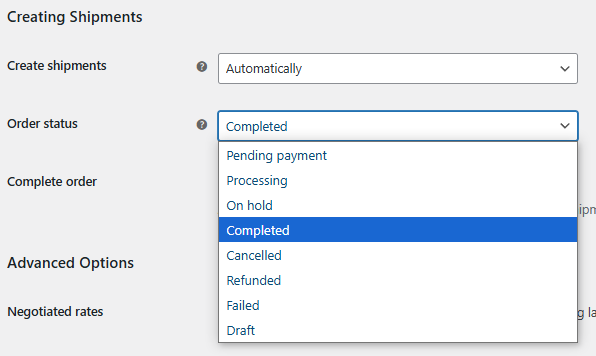
Order status
If you have chosen to create shipments automatically, then the second input about order status is available. You should choose desired status for automatic shipment creation.
Order number as reference
If you would like to display order number as reference on the label, tick the checkbox below:

Advanced Options
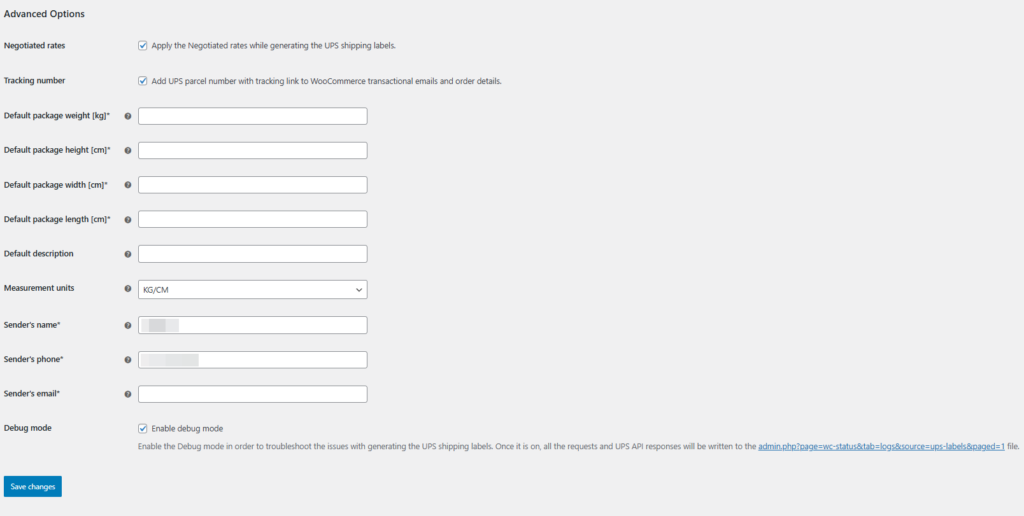
Negotiated rates
– option enabled by default. If ticked and if you have the Negotiated rates assigned to your account, they will be used and applied while generating the UPS shipping labels. This in turn should result in reducing the shipment’s cost.
Tracking number
– tick this checkbox if you want the parcel tracking link to be added to the WooCommerce transactional emails sent to your customers once their order is shipped.
Default dimensions
It is possible to adjust the dimensions of the package directly in the global settings if they are not set in the shipping method or they will be not imported from the UPS Live Rates plugin. Apart from importing the dimensions of the package from the UPS Live Rates(UPS Live Rates shipping method has to be configured), the UPS Labels also divides the package on several packages, if in the UPS Live Rates plugin several packages have been configured.
Default package weight
– enter the weight value which will be used as default if the individual product’s weight has not been filled in.
Default package height
– enter the height value which will be used as default if the individual product’s height has not been filled in.
Default package width
– enter the width value which will be used as default if the individual product’s width has not been filled in.
Default package length
– enter the length value which will be used as default if the individual product’s length has not been filled in.
Default description
This description will be used as the default if no description is set for the shipping method.
Measurement units
– choose the measurement units the plugin should use. The units set in the WooCommerce settings at WooCommerce → Settings → Products → General → Measurements are used by default.
If you encounter the This measurement system is not valid for the selected country error, please switch the units. Once it is done they will be converted into the ones required by UPS API.
Name of sender
– fill in these field with the name of the entity the ordered products are sent from, e.g. enter your shop’s or your company’s name here.
Phone of sender
– fill in this field with the phone number of the entity the ordered products are sent from, e.g. enter your shop’s contact phone here.
Let’s talk! Discuss your shipping challenges 1:1 with a real human to ensure you get a setup that actually delivers results.
Talk to an ExpertEU import customs data
Available from UPS Labels 3.4.0, these settings provide default customs data for shipments sent from outside the European Union to EU destinations. The feature requires an OAuth — REST API connection.
Go to WooCommerce → Settings → Shipping → UPS Labels and find the EU import customs data section.
Prepare your product attributes
Create global product attributes in Products → Attributes for the manufacturer part number (MPN), HS code and country of origin. Assign the appropriate values to your products, then select these attributes in the settings below.
Choose No attribute if you do not want to obtain a value from a product attribute. You can enter the missing data directly in each shipment before creating its label.
Manufacturer part number attribute
Select the global product attribute containing the manufacturer’s part or model number. The plugin uses its value as the Manufacturer PID.
A global identifier such as EAN, UPC or GTIN does not replace a missing MPN.
HS code attribute
Select the global product attribute containing the product’s customs tariff code. Enter the code as 6–15 digits without spaces or punctuation.
Country of origin attribute
Select the global product attribute containing the product’s two-letter country of origin code, such as CN or GB.
Use the country of origin of the goods, which may differ from the country you ship them from.
Default sender type
Choose Business or Private individual as the default sender type. The default setting is Business.
You can change this value in an individual shipment.
Default receiver type
Choose Business, Private individual or Select in each shipment. The default setting is Select in each shipment.
Select the type that accurately describes the receiver. The plugin does not determine it from the company name entered in the order. You can change the receiver type in an individual shipment.
Where product identifiers come from
| Identifier | WooCommerce source |
|---|---|
| Merchant PID | The SKU of the product or variation being shipped. |
| Manufacturer PID | The value of the selected manufacturer part number attribute. |
| Standardised PID | The product’s native WooCommerce global unique identifier, such as EAN, UPC or GTIN. |
If you use a separate plugin to manage GTINs, make sure it also populates the native WooCommerce global unique identifier field. UPS Labels does not automatically read arbitrary custom fields.
For variations, enter the SKU and global unique identifier on the individual variation. These identifiers are not automatically copied from the parent product.
For MPN, HS code and country of origin, the plugin first checks the selected attribute on the variation. If it is empty, it checks the same attribute on the parent product. Make sure any inherited value correctly describes the variation being shipped.
Review the customs data and product identifiers in the shipment before creating its label.