
- Home
- WooCommerce
- What plugin are you looking for?
- Shopify
- Find my product
- About us
- Blog
- Docs
- Contact us
- What can we help you with?

WooCommerce shipping by cart total means that the shipping cost depends on the value of the customer’s order, so the rate changes as the cart grows. WooCommerce doesn’t offer price ranges out of the box, so this guide covers what the default Flat Rate can and can’t do, how to set shipping cost by price with a free plugin, how to charge a percentage of the order value, and which mistakes to avoid. You’ll also find updated research on how shipping fees affect checkout.
Shipping by cart total, also called shipping cost by price or price-based shipping, means the shipping cost depends on the order value. You define price ranges, or a percentage, and WooCommerce shows the matching cost in the cart and at checkout. There are two common approaches:
For example, this set of tiers charges less as the order grows and makes shipping free from $200:
| Cart total | Shipping cost |
|---|---|
| $0.00 to $49.99 | $8.00 |
| $50.00 to $99.99 | $5.00 |
| $100.00 to $199.99 | $3.00 |
| $200.00 and more | Free |
Because shipping fees decide whether many customers finish a purchase, and small orders are the most sensitive to them. Recent research points in the same direction:
These are self-reported surveys, not guarantees. The practical lesson is to keep the cost low for small orders, lower it as the cart grows, and show customers the final price early. To show how much more they need to spend, you can add a free shipping bar.
Only partly. WooCommerce has no built-in table of price ranges, but its Flat Rate method can charge a percentage of the order value, and its Free Shipping method supports a minimum order amount.
In WooCommerce → Settings → Shipping, open a zone, add or edit Flat Rate, and enter a formula in the Cost field. The [fee] placeholder takes a percent argument and optional min_fee and max_fee arguments (WooCommerce documentation):
10 + [fee percent="10"]

[fee percent="5" min_fee="4" max_fee="10"]
The first formula charges $10 plus 10% of the order total. The second charges 5% of the order, with a minimum of $4 and a maximum of $10: a $50 order pays $4 (5% would be $2.50), a $120 order pays $6, and a $300 order pays $10 (5% would be $15). Costs you enter in WooCommerce are excluding tax. Use straight quotes in the formula, because curly quotes copied from a document stop it from working. What the default methods can’t do is use different costs for different price ranges, such as $8 under $50 and $5 from $50 to $99.99. For that, you need a table rate plugin.
Install the Flexible Shipping plugin, add a Flexible Shipping method to your shipping zone, and add one rule for each price range. Price-based shipping is built into the free version. Flexible Shipping is an Octolize plugin with 100,000+ active installations.

The best Table Rate Shipping for WooCommerce. Period. Create shipping rules based on weight, order totals, or item count.
Go to WordPress.orgorDownload for free“Happy to recommend it. Easy to configure and no conflicts so far.”
— originalpwah, WordPress.org review, August 2026
Go to Plugins → Add New Plugin, search for Flexible Shipping, click Install Now, and then Activate. On WordPress.org, it’s listed as “Weight Based Shipping Table Rate for WooCommerce – Flexible Shipping”.
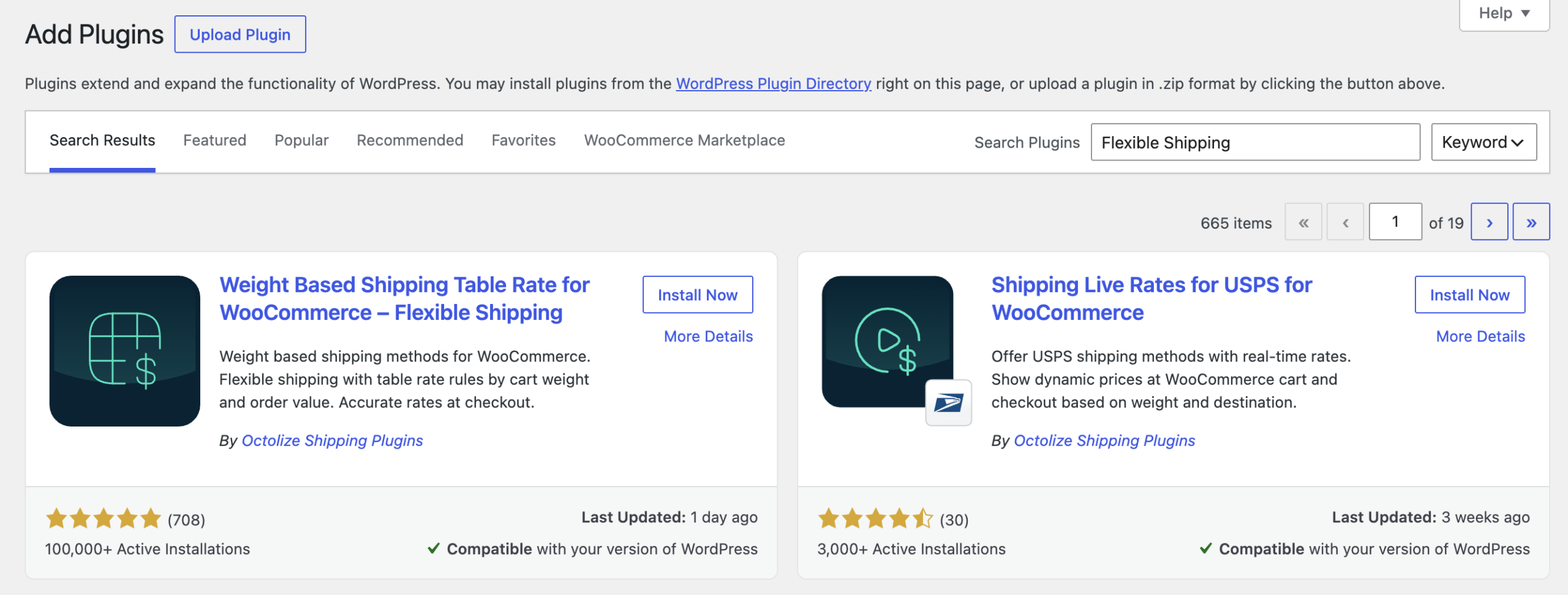
You can also download it from WordPress.org.
Go to WooCommerce → Settings → Shipping and open the zone you want, for example “United Kingdom” or “United States”. Click Add shipping method, choose Flexible Shipping, and confirm.
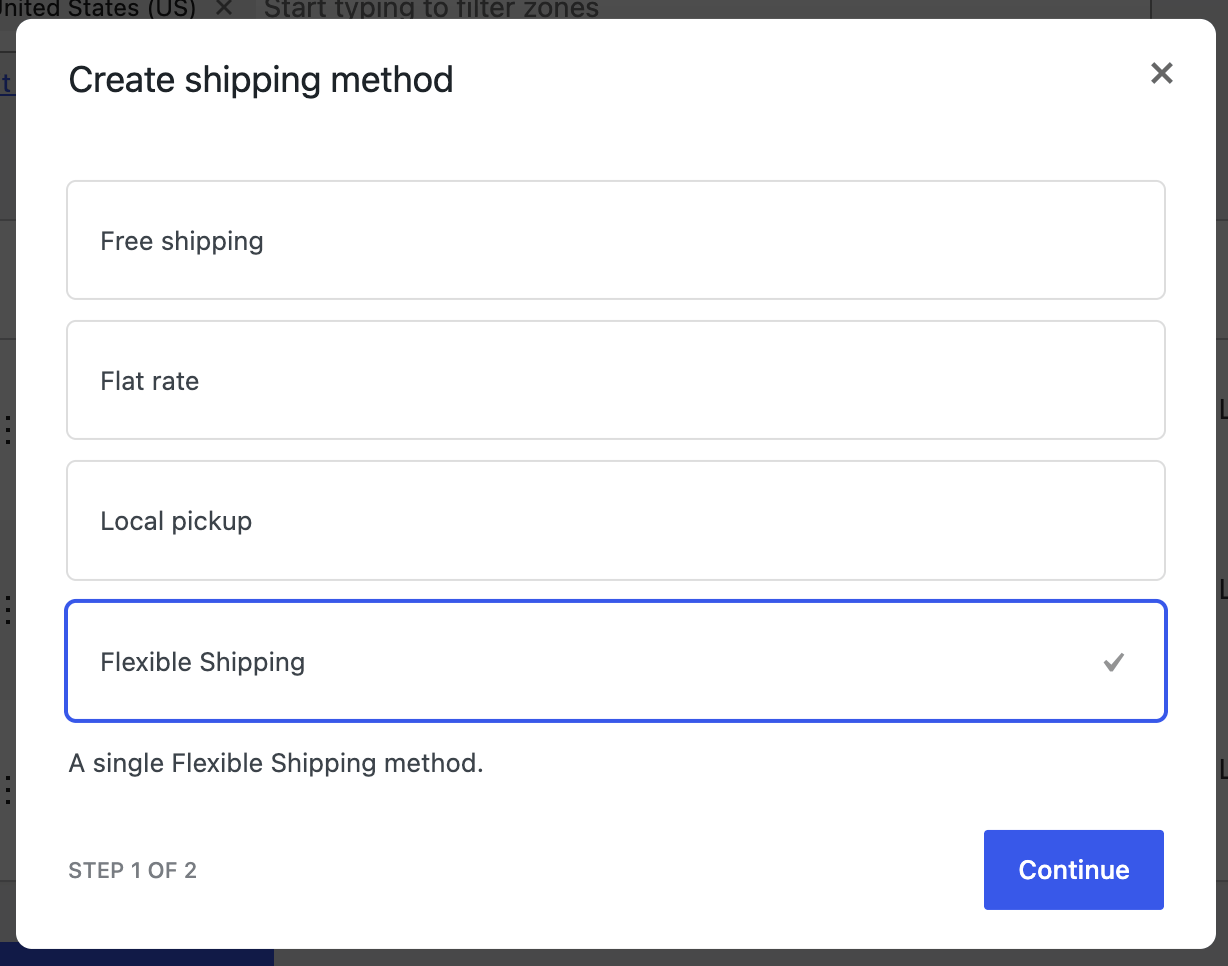
Then click the new method to edit it.
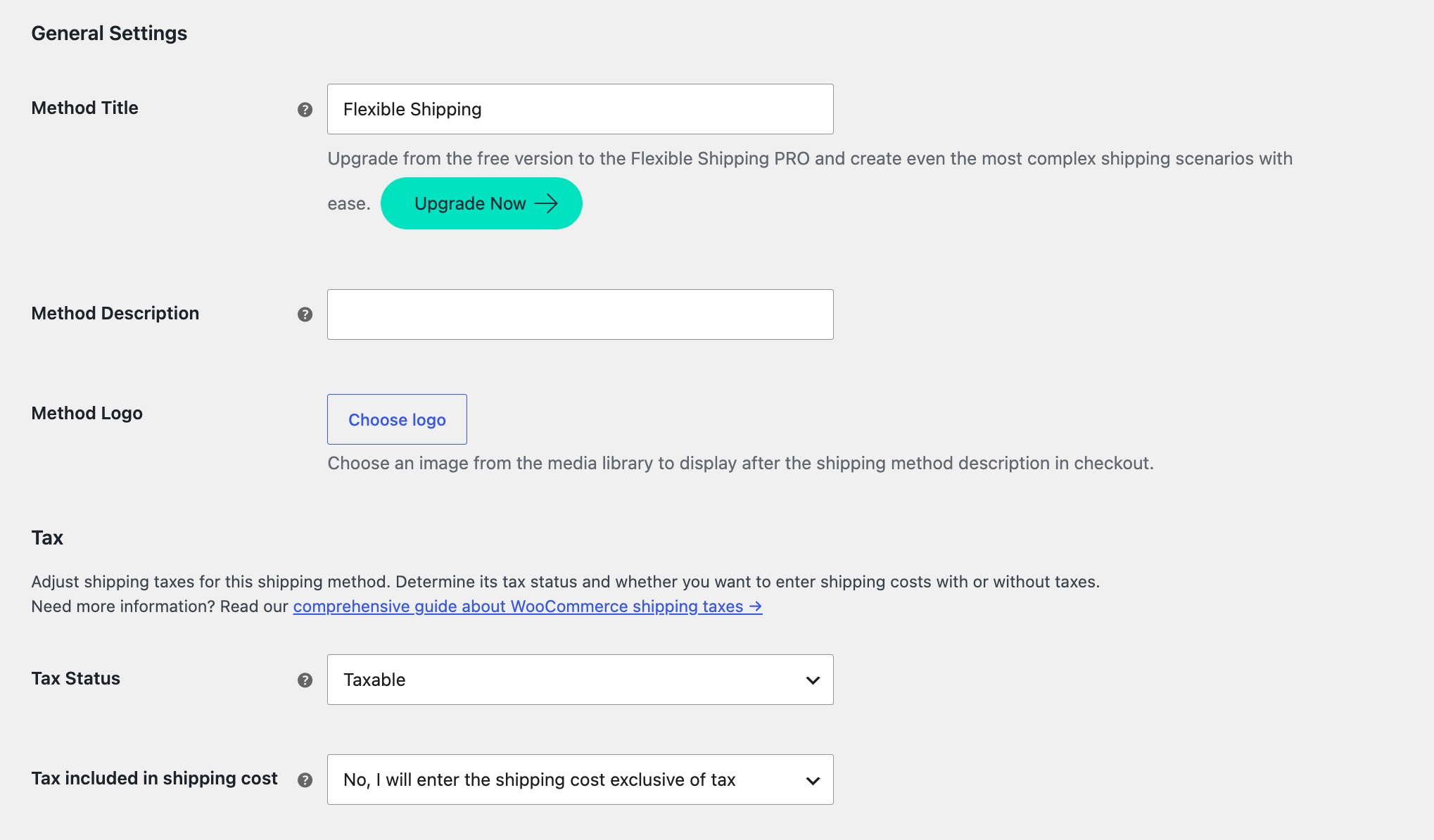
In the method’s general settings, enter a Method Title, which customers see at checkout, for example “Standard shipping”. You can also add a short description in the Method Description field or even add a WooCommerce shipping method logo.
Scroll to the Shipping cost calculation rules table. For each range, click Add rule and set When: Price, then the from and to values, and the rule cost is. For the tiers above, you’d add four rules:
0 to 49.99, rule cost 850 to 99.99, rule cost 5100 to 199.99, rule cost 3200, to left empty, rule cost 0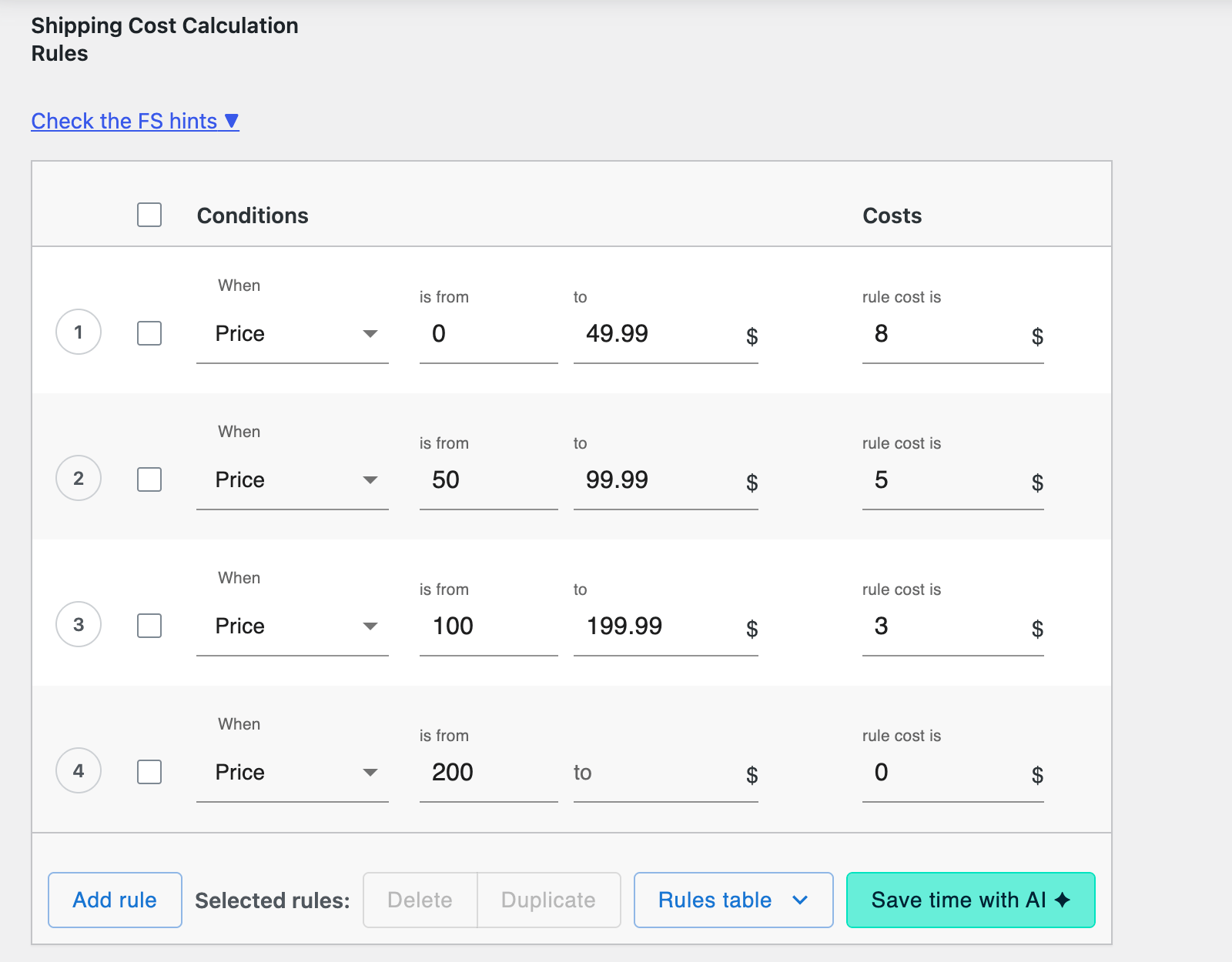
End each range just below the start of the next one, and leave the last to field empty so the rule covers every higher cart total.
Click Save changes. Add products to the cart so that the total is just below, exactly at, and just above each range limit, and check the shipping cost at checkout. If a cost doesn’t show as expected, enable Debug Mode, which shows why a method was or wasn’t displayed.
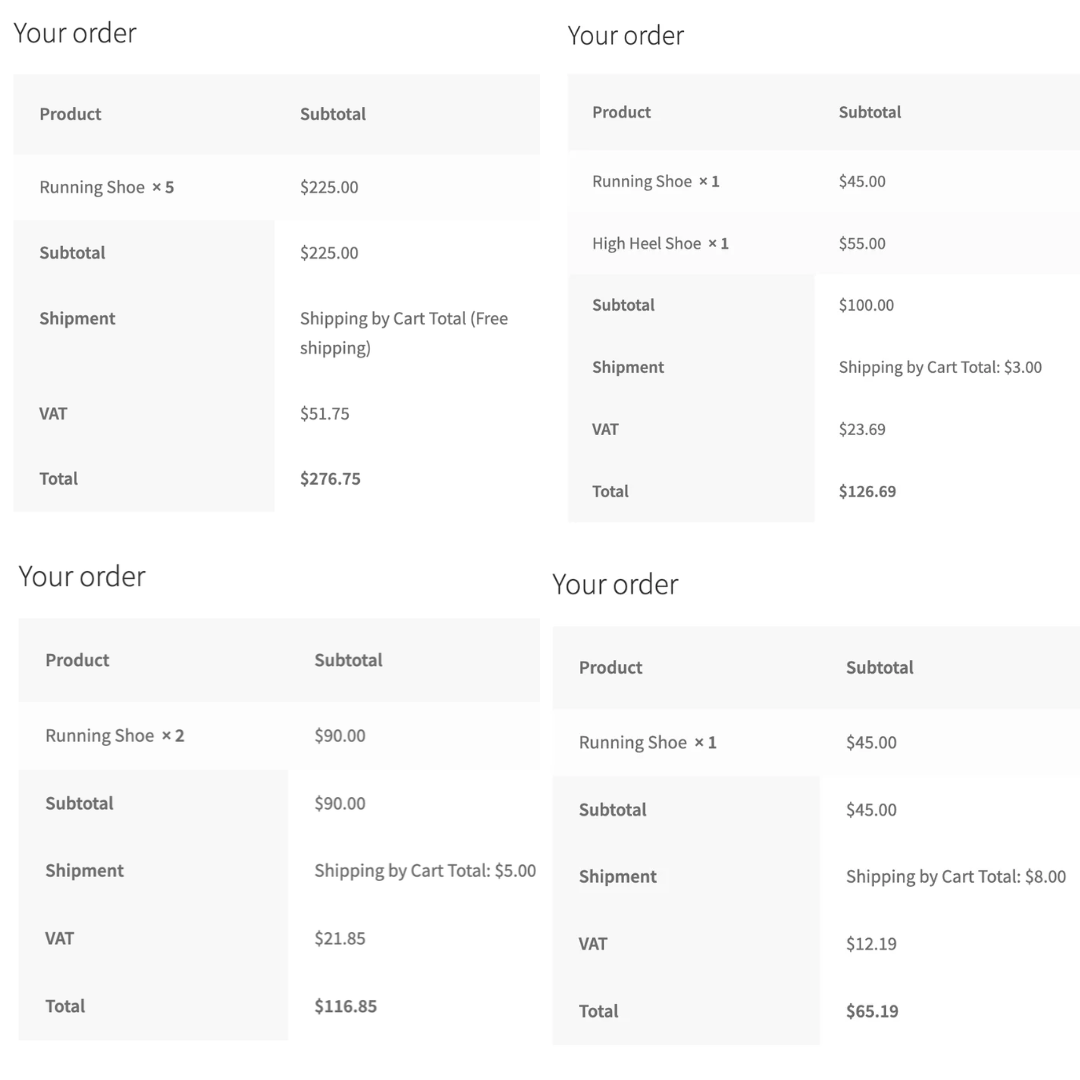
You can see from my example how the shipping cost changes depending on the cart total:
Prefer to watch? You can find information about shipping based on the order total in the video tutorial for the free version of the Flexible Shipping plugin.
Free shipping from a certain amount can also be set with a threshold instead of a rule with a cost of $0. See our guide to WooCommerce free shipping over amount.
For a single percentage with a minimum and a maximum, use the Flat Rate formula shown above. For percentages combined with price ranges and other conditions, use Flexible Shipping PRO.
A percentage works well when your orders vary widely in value, but it grows with the cart: 1% of a $50 order is $0.50, while 1% of a $626 order is $6.26. That’s why you should set a maximum, or a free shipping threshold, so a large order never pays more than customers accept. The same goes for any formula that changes with every $100 spent. Give it a floor and a cap, so the cost never drops to zero or below by accident.
Flexible Shipping PRO lets you set the cost of a rule as a percentage of the order value, so you can use, for example, a different percentage for each price band. See the documentation: Shipping cost as a percentage of the order’s value.
The best Table Rate Shipping for WooCommerce. Period. Create shipping rules based on weight, order totals, or item count.
View DetailsorAdd to cartIt means the shipping cost depends on the order value, either per price range (for example, $8 under $50 and $5 from $50) or as a percentage of the order. It’s also called shipping by cart total or price-based shipping.
For price ranges, yes, because WooCommerce has no built-in table of ranges. For a percentage of the order value, the default Flat Rate method is enough: use a formula such as [fee percent="5" min_fee="4" max_fee="10"].
Yes. Rules based on the cart total, a free shipping threshold, and weight rules are included in the free version. A percentage of the order value in the rules table and conditions such as item count or user role need PRO.
Add a rule from that value with a rule cost of 0, or set a free shipping threshold in the method. If you use a threshold, make sure your rules also cover the range above it.
Yes. Use the Flat Rate formula with [fee percent="..."] and optional minimum and maximum fees, or Flexible Shipping PRO if you want a percentage inside price rules.
WooCommerce doesn’t display a shipping method for that zone, so customers can’t complete the order. Cover all price ranges and leave the last “to” field empty.
Flexible Shipping uses the cart value as WooCommerce calculates it, so coupon discounts are already applied. Whether the amount includes tax depends on your tax display settings and the method’s tax options, so test it with a sample cart.
Yes. Add a Flexible Shipping method to each shipping zone and set its own rules. For different rates for different customer types, such as retail and wholesale, use the user role condition in Flexible Shipping PRO.
Yes. Price and weight rules work together in the free version. Conditions such as item count, line items, and shipping classes need PRO.
Usually, the customer’s address doesn’t match the shipping zone, or no rule matches the cart total. Caching can also show an old cart. Check the zone and the rules, exclude the cart and checkout pages from caching, and use Debug Mode to see which rule was triggered.
Shipping by cart total lets the shipping cost follow the value of the order, and the research from Baymard, Ryder, AlixPartners, and ShipBae shows why that matters: shipping fees decide whether many customers finish a purchase, and small orders tolerate very little. WooCommerce’s Flat Rate can charge a percentage of the order, but price ranges need a table rate plugin, and Flexible Shipping includes them in its free version.
Whichever approach you choose, keep fees low for small orders, lower them as the cart grows, cover every price range, and test the boundaries before going live. When you’re ready to go further, our guide to WooCommerce free shipping over amount shows how to add a free shipping threshold on top of your tiers.

Content Writer at Octolize
Bartosz Gajewski is a content and marketing specialist with a solid background in SEO, WordPress content strategy, and technical documentation for digital products. With years of hands-on experience in both in-house and freelance roles, he supports tech companies – especially in the SaaS and e-commerce space – by creating content that informs, engages, and drives results.
His approach blends storytelling with data-driven SEO, and he’s been involved in projects ranging from rebranding and product marketing to growth experiments and copywriting for complex software tools. On the blog, he shares actionable insights from his work across marketing teams, product documentation, and online store optimization.





Learn how Octolize helped Kurzgesagt, the online shop behind one of YouTube’s most popular science channels, set up conditional courier rules using the Shopify Shipping Rates Rules & Zones app.

Learn how Octolize solutions helped WooCommerce store based in the United Kingdom set up shipping scenarios.
Learn how Octolize helped Shopify store based in the USA set up distance based rates with a usage of Octolize Distance Based Rates.
 Pickup Points

This article saved the day for me. What a sweet and simple way to used custom shipping rates based on cart totals. You have no idea how much this article has helped me, thank you very much!
Thank you for kind feedback, I am very glad that the tips presented have helped you in the configuration of the shipment.
Hi,
Is it possible to calculate the shipping cost on the Subtotal, instead of the total?
When I apply a Coupon the price goes down but I’d want to maintain the shipping cost the same, is it possibile to do this?
Thanks,
Matteo
Hi Matteo, I’m afraid it is unfortunately not possible yet at this moment. Our Flexible Shipping plugin hooks into the WooCommerce calculation methods and takes
the values from the cart, where the discounts are already applied. However, we receive many questions from our customers about such feature and we plan to implement it in the one of the future updates.
With this plugin, can you calculate the shipping costs on the total price of the products, including VAT? On my chekout page, products appear without VAT and shipping costs are calculated in the subtotal without VAT. I need to calculate the expenses on the total, including VAT. If so, how would it be done, because I can’t find a way to do it?
Thank you so much.
Hello Angel, Flexible Shipping hooks into and uses the product’s price so if you have set the prices to be exclusive of tax: http://wpdesk.me/mp/qw54w.png, our plugin won’t add the tax while calculating the shipping costs. To have the tax included you will need to turn it on in the shipping method and set the prices to be displayed with tax at WooCommerce Tax settings: http://wpdesk.me/mp/qw54w.png.
Hi Lukasz.
Thank you very much for your answer.
Super helpful and the cart based shipping cost is exactly what I needed. Thanks!
Thank you for the kind words. We’re glad it met your needs.
I have followed through the instructions, cleared all the caches I can find but for some reason none of my flexible shipping costs show on either of mine or my nephews mobile devices, at the moment they show no shipping costs at all. Any help or advice will be greatly appreciated
Hi Caroline, from what you have written I suppose something wasn’t configured properly. Maybe the shipping zone isn’t matched right or your shipping methods’ cost calculation rules are not being triggered correctly. Have you tried enabling the Debug mode at Flexible Shipping method’s configuration screen Advanced Options section?
Hi All,
I have issue regarding the flexible shipping charge.
How can I add flexible shipping charges based on total while ordering the products?
How can we adding custom / manually code?
Any help or advice will be greatly appreciated.
Hi Nitesh, just to make sure if I got everything right – do you want the shipping cost to be fixed value, e.g. $15 and want to have it applied based on the order total price or should be calculated dynamically as a percentage of the order total value, e.g. always 10%?
can you have different rates for different amount to different countries
Hi Nick, sure, you can define the different rates and different shipping cost calculation rules for each Flexible Shipping method within every shipping zone you have configured in your shop.
Can rules be based on Distance? Not cost? For examle, if distance is from 0 to 10 km – the total shipping is 5 dollars e t c. thanks
Hi Maria, I’m afraid that unfortunately defining the shipping cost calculation rules based on the distance the way you described it is not possible at the moment using our Flexible Shipping PRO plugin. Nevertheless, since we are being frequently asked about such possibility, we plan to implement it in the one of the future updates. I’ve added you to the list of people interested in such feature and you will be notified as soon as the proper update is released.
@Maria Some time ago, you asked us about a distance-based shipping cost.
I’m glad to inform you that we have just released a brand-new Flexible Shipping add-on – Distance Based Shipping Rates for WooCommerce.
You can now use this plugin to define the cost calculation rules to be based on the distance or duration of the products’ delivery between your store and the customer’s address. This plugin works with Google Maps API.
Looking forward to your feedback!
This is very helpful article for me. it’s save my lot’s of time and tension.
Will this work if there are 2 types of customers each with their own set of shipping values? For example – Retail Orders ship free on orders over $95; Wholesale Orders ship free on orders over $250.
Hi Darren, you can achieve such a scenario based on condition USER ROLE. This condition is available in the Flexible Shipping PRO. The best option here would be creating 2 shipping methods – 1st for retail order and 2nd for Wholesale Orders. Please have in mind that this will work, if your customers will have assigned proper user role.