
- Home
- WooCommerce
- What plugin are you looking for?
- Shopify
- About us
- Blog
- Docs
- Contact us
- What can we help you with?

Subscribe to our newsletter
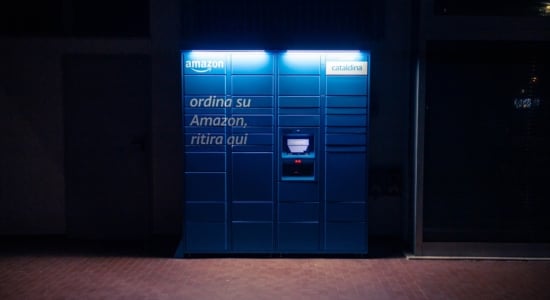
Customers want the most efficient and convenient buying experience possible in today’s digital world. The PUDO delivery service, which stands for Pick-Up/Drop-Off, enables consumers to collect or drop off their orders in a secure point close to them.
In this blog post, we will look at the advantages of adopting PUDO, why businesses should think about including it as a choice on their e-commerce site, and how it may elevate the customer experience. We will finally look at how to begin integrating PUDO into your online business, and what to expect from the future development of PUDO delivery services.
PUDO is a creative response to the shipping issues faced by many companies. Offering this delivery option in your e-commerce store boosts sales and improves customer experience due to its convenience, punctuality, and flexibility.
The benefits don’t end at the customer: aside from growing consumer loyalty, PUDO helps your store minimize shipping costs, deliver with higher efficiency, and experience fewer returns due to delivery issues.
The growing popularity of PUDO services drives both multinational giants, such as DHL or GLS, and regional carriers to invest in expanding their PUDO networks. Soon, PUDO will become the new norm, and if you don’t jump on that wagon now, you will be left behind.
PUDO stands for Pick-Up/Drop-Off. The goal of PUDO delivery is to allow online buyers to collect their orders from pickup points in locations of their choice instead of having them delivered to their doorstep. It is a convenient option for customers who cannot or do not want to have packages sent to their homes.
There are two main types of PUDO points. Customers can choose from:
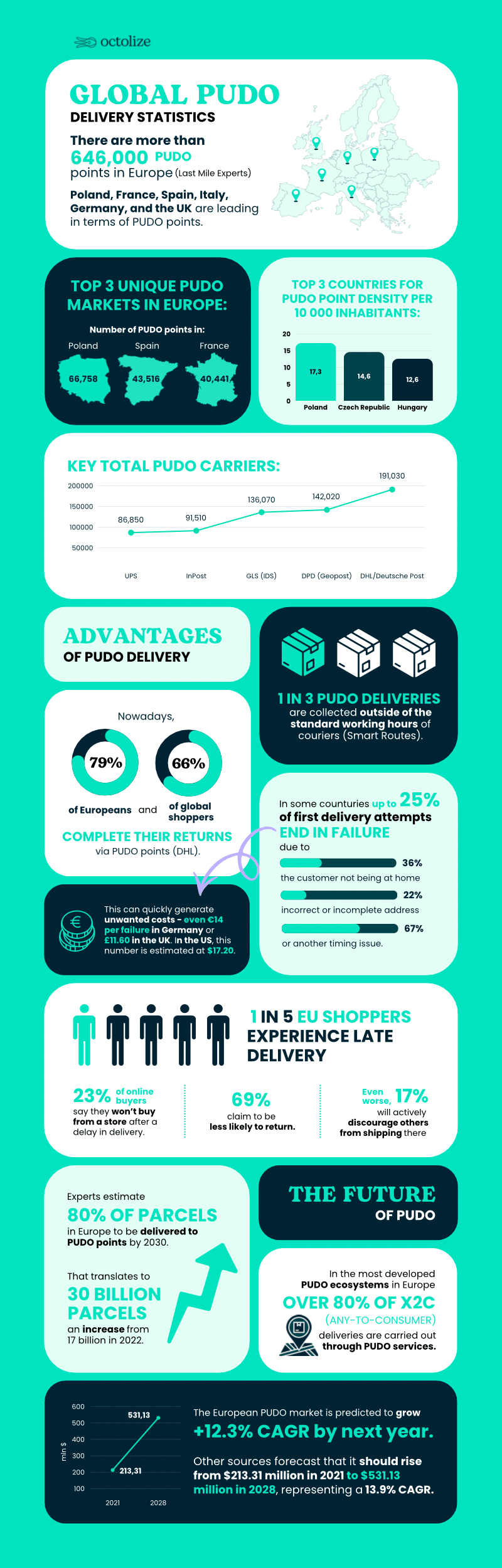
Europe definitely takes the lead when it comes to the popularity of PUDO globally. There are more than 646,000 PUDO points scattered across this region, according to a 2025 study by Last Mile Experts. Poland, France, Spain, Italy, Germany, and the UK are leading in terms of PUDO points.
Poland (17.3), the Czech Republic (14.6), and Hungary (12.6) take the podium when it comes to PUDO density rate per 10,000 inhabitants.
These numbers also correspond with the global delivery preferences: countries with the highest density rate for PUDO points are also the most likely to choose this delivery type (DPD).
|
Country |
Number of PUDO points |
|
Poland |
66,758 |
|
Spain |
43,516 |
|
France |
40,441 |
Data source: Różycki, M. and Gral, M. (2025) Out-Of-Home Delivery in Europe Report 2025, Last Mile Experts
The U.S. is still behind Europe in terms of the number of pickup points, although its popularity is growing significantly.
*these 2 companies signed a deal to share PUDO points
Here, there is an important distinction to make. The data above demonstrates the total number of PUDO points across Europe, but it compiles 2 kinds:
In terms of parcel lockers, DHL, InPost, and DPD are the winners. However, many consider InPost to be the leader in this area, as its lockers usually have more cells on average.
When it comes to other PUDO points, the podium is taken by DHL, GLS, and DPD.
You can find many names on the market for pick-up and drop-off services. In fact, each courier company uses its own term for PUDO delivery:
However, all these services are quite similar and show that almost all courier companies see the potential of such a solution. It’s time for you to see it, too.
Using PUDO in your online business is a fantastic approach to elevate your consumers’ shopping experience. Customers can pick up their goods from nearby places, which lowers the possibility of parcels being stolen, lost in transit, or damaged if left in an unsafe spot.
Shoppers can also collect orders while they are out and about and avoid the delays that come with conventional home deliveries. Additionally, providing PUDO as an option guarantees that consumers can easily trace their orders from dispatch through collection or drop off. As a result of your clients knowing that their package is secure throughout transit, you will gain their trust.
Picking up a package at a time of their choosing is by far the most convenient solution for many e-commerce customers. Additional delivery alternatives give busy clients the option of picking up their packages while they’re out and about. This leads to increased levels of client satisfaction and decreased failed deliveries.
A huge advantage of PUDO is that it is easier to conduct returns of purchased goods. E-commerce customers have more and more rights, resulting in increased returns. Convenient returns are certainly an added benefit for users, affecting the customer experience.
Nowadays, 79% of Europeans and 66% of global shoppers complete their returns via PUDO points (DHL). Safe to say, the majority of online buyers prefer this option.
1 in 5 customers declare their preference for self-selected delivery windows (Smart Routes). Offering PUDO delivery goes a step further – shoppers don’t even have to pick a specific delivery time slot, but get 48 hours to collect their parcel at any time they want.
Findings by Connect+ support this, stating that almost 1 in 3 PUDO deliveries are collected outside of the standard working hours of couriers. That means 27% of collections would have likely ended with a failed delivery attempt that can be avoided thanks to PUDO points.
In some countries, up to 25% of first delivery attempts end in failure (Smart Routes) due to the customer not being at home (36%), incorrect or incomplete address (22%), or another timing issue (67%) (Alexander Jarvis).
The average number of delivery attempts at DPD is 2. This can quickly generate unwanted costs – even €14 per failure in Germany or £11.60 in the UK (Smart Routes). In the US, this number is estimated at $17.20. (Alexander Jarvis). It’s precisely what leads to carriers hiking up their prices, directly impacting your own business costs.
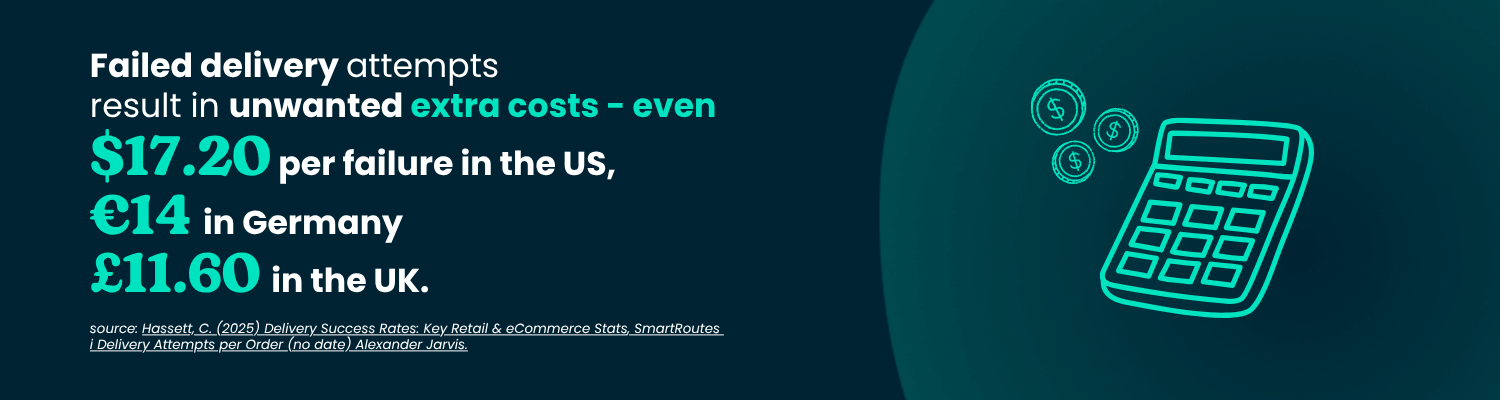
Offering PUDO delivery dramatically minimizes the risk of failed deliveries, contributing to a higher deliverability and money saved for everyone involved: your business, courier companies, and customers.
There may be deliveries that customers would prefer not to collect directly from a courier. In such cases, parcel lockers create a comfort buffer, granting such shoppers anonymity.
PUDO points allow carriers to drop off several parcels at the same spot. It saves them miles of driving around to individual customers, saving not only money and time, but also limiting fuel consumption. Studies show that group deliveries help cut last-mile CO₂ emissions by up to 82% (Last Mile Experts) on fewer miles and limited return trips after failed delivery attempts. Another source estimates this number for just parcel lockers at 35% (Clever Maps).
Many companies are also working on introducing solar-powered parcel lockers in order to make this delivery method even more sustainable.
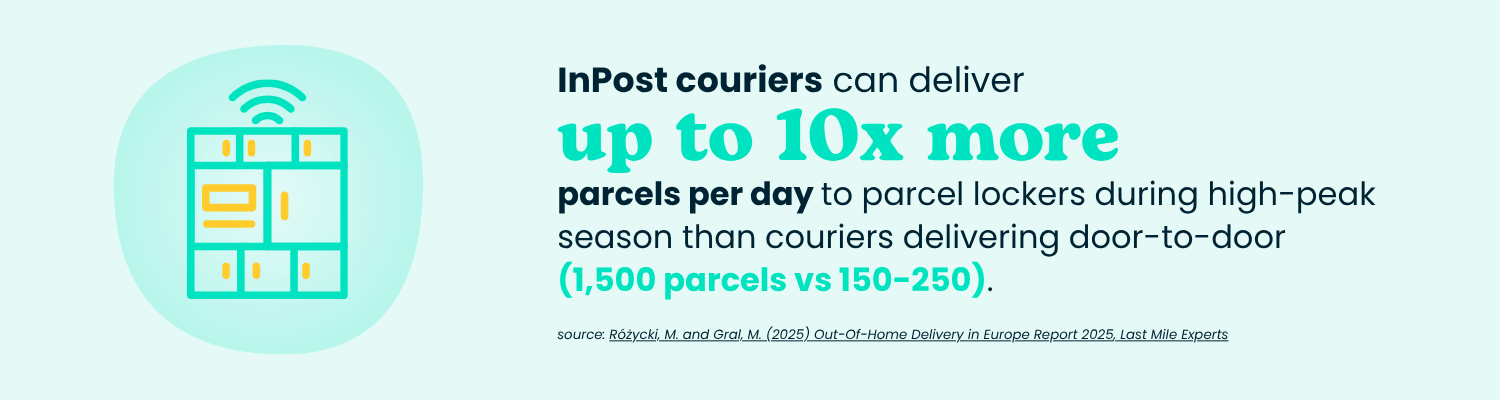
The lower rate of failed delivery attempts saves couriers time on return trips. This means they can use that time to deliver more parcels every day. InPost couriers are said to deliver up to 1,500 parcels per day to lockers during peak season.
These numbers for classic, door-to-door delivery oscillate between 150 and 250 parcels per day (Last Mile Experts). This means PUDO points can increase the daily number of orders delivered up to 10 times. All this without the need to deploy more vehicles or drivers.
1 in 5 EU shoppers experience late delivery (Ecommerce News). 23% of online buyers say they won’t buy from a store after a delay in delivery (Sendcloud), and 69% claim to be less likely to return (Opensend). Even worse, 17% will actively discourage others from shipping there (Sendcloud).
These numbers show you can’t afford to fail to deliver your products on time. Due to the limited return trips and deliveries centered around fewer spots, PUDO delivery is generally less prone to delays than standard door-to-door.
Customers like having a choice. You offer different versions of products and various payment methods – they also want to see a selection of delivery options. 57% of online shoppers claim they will abandon their carts if they don’t find their preferred delivery method at checkout (Geopost/DPD Group).
That’s more than half of your orders gone because of an issue that’s easy to solve. Right now, 25% of global consumers choose PUDO delivery (DHL). 1 in 4 clients is already a number you can’t afford to lose – and it will only grow in the coming years, as more than 60% already view this service positively (Qapla).
Offering PUDO delivery is an excellent method to improve your customer experience. You may shorten delivery times and provide a simple tracking system so that buyers can keep up with the status of their purchases. You are also giving your customers the option to pick up their products from their preferred locations.
As a result, your consumers will trust you more for your transparency and flexibility. Furthermore, providing this service enables more flexible scheduling possibilities, which may boost sales by luring in impulse buys or assisting busy shoppers to suit last-minute orders. Also, offering PUDO as an alternative lowers mailing costs, which could potentially be passed along to the client in the form of discounts or promotions.
Introducing PUDO delivery in your online store is easy. First of all, choose the kind of service you want to offer. Contact the couriers you already work with to inquire about PUDO services.
Having enrolled, it is time to incorporate PUDO into the checkout process on your website. The simplest solution is to use a ready-made integration. You will find many solutions that allow you to display a map with pickup points on the checkout page for specific couriers on the market.
At Octolize, we offer high-quality PUDO delivery tools for two top e-commerce solutions: WooCommerce and Shopify.
With this powerful plugin, you can offer pickup points for 51 carriers – both international and regional. It works out of the box, saving you the hassle of signing additional agreements with carriers or configuring third-party integrations.
The list of available pickup points is updated several times a day, granting you the comfort of knowing it’s always accurate and never shows outdated locations. You can also choose from a list and map view, displaying pickup points nearest to the customer’s address and saving the details for future orders.

Let your customers collect their orders from their local pickup point with 47 carriers worldwide.
View Details or Add to cartSee it in action! Watch the full Pickup Points PRO video here:
This WooCommerce plugin allows you to give your clients access to the automatically calculated shipping costs for a variety of UPS services and gives them the option to select the Access Points of their choice. It can automatically suggest the nearest Access Points, or let your customers use the in-built search.
Display automatically calculated UPS live rates and offer UPS Access Points support for your customers.
View Details or Add to cartThis plugin makes it possible to include the DPD UK & DPD Local Pickup Locations for your customers at the checkout page. This way, they can easily choose from available pickup points near their address. Combined with the DPD UK & DPD Local WooCommerce plugin, allows you to fully embrace DPD UK fulfillment in your WooCommerce store.
Ship your DPD orders faster. Automatically collect shipping details, download printable shipping labels, and track parcels.
View Details or Add to cart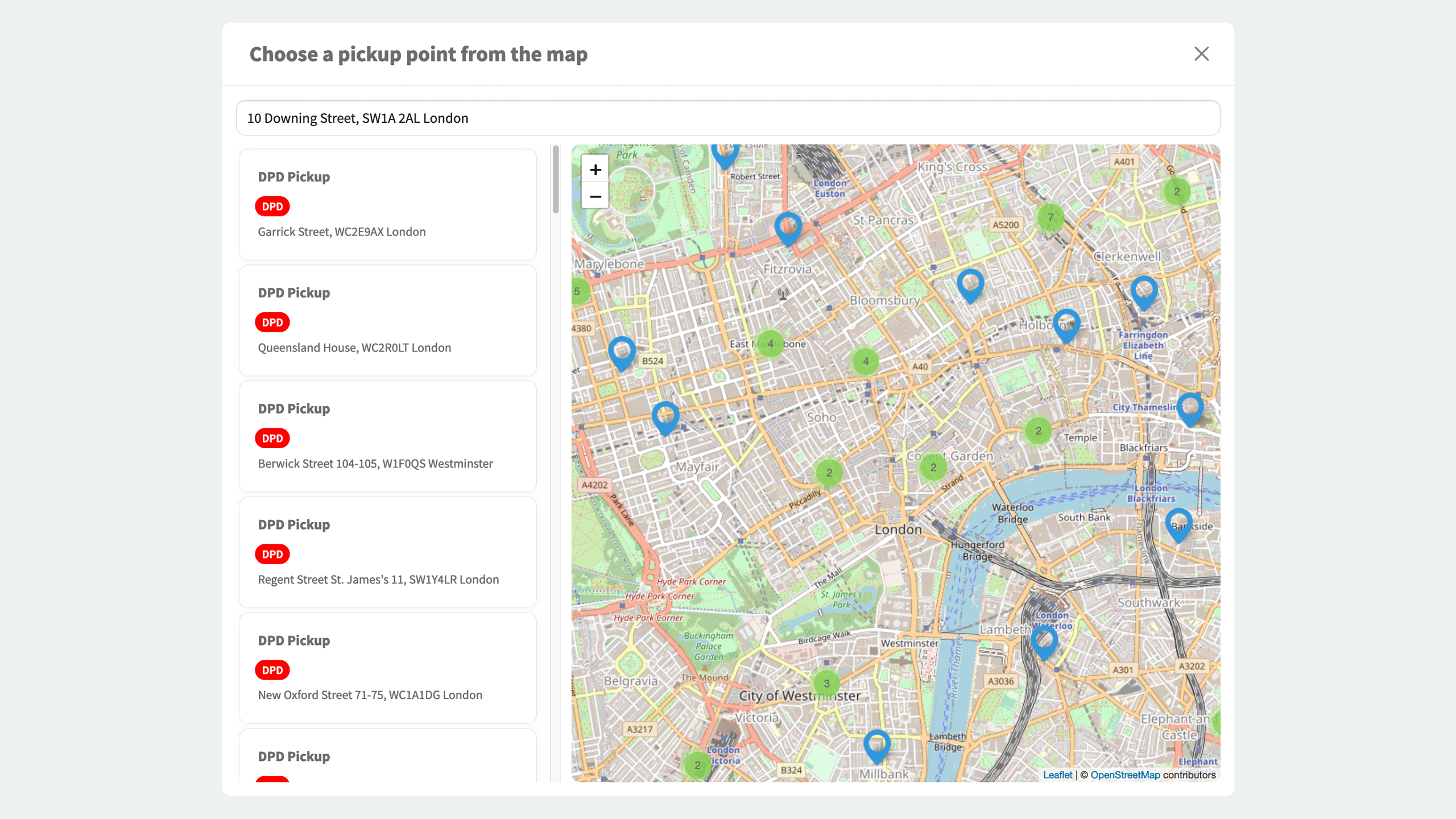
This app allows you to offer your customers a choice of pickup points from 51 local and international carriers in your Shopify store. It sidesteps the checkout limitations in the Shopify Basic plan, letting you include the choice of PUDO delivery in the cart instead.
*What’s more, you can also decide how the shipping cost should be calculated when delivering to pickup points. Choose between price-based and weight-based cost calculation rules to offer fair pricing to customers and make sure you don’t lose money on delivery at the same time. You may also add a free pricing threshold as an incentive for spending more in your store.
*For technical reasons, these features are available for Shopify Plans that enable Carrier Service API access
If someone isn’t convinced by the current numbers regarding the popularity of PUDO delivery, they cannot deny one fact: they will be growing. Experts estimate 80% of parcels in Europe to be delivered to PUDO points by 2030. That translates to 30 billion parcels – an increase from 17 billion in 2022 (Clever Maps).
What’s more, the European PUDO market is predicted to grow +12.3% CAGR by next year (Statista). Other sources forecast that it should rise from $213.31 million in 2021 to $531.13 million in 2028, representing a 13.9% CAGR (Business Market Insights).
In the most developed PUDO ecosystems in Europe, over 80% of X2C (any-to-consumer) deliveries are carried out through PUDO services (Last Mile Experts).
Another proof of the growing importance of PUDO delivery is the rising partnerships. The system is becoming a tightly-knit network, with carrier companies and top consumer brands entering PUDO collaborations.
For example, in Poland, the top market for PUDO in Europe, GLS has partnered with Orlen Paczka, a local carrier service – the latter now allows GLS to use its network of pickup lockers for deliveries.
Another giant, DHL, entered a collaboration with Poste Italiane and CTT Expresso, developing its PUDO services for Italy and the Iberian Peninsula.
In Austria, Temu and supermarket chain Spar joined forces with Austria Post, with the latter installing over 100 new pickup points in front of Spar stores across the country (Parcel And Postal Technology International). Temu, on the other hand, plans to expand into Slovakia, Bulgaria, and Hungary next.
Meanwhile, in the UK, the delivery company Evri is investing £50 million in a new chain of pickup lockers (Parcel and Postal Technology International).
The scale of such collaborations all over Europe signals that this is the direction carrier companies intend to go. They are increasingly investing in the expansion of PUDO services, hinting at a decision to switch their focus to this delivery type.
Experts predict that the PUDO delivery will undergo a significant evolution in the near future. We should expect to see dynamic pricing options, subscription-based models, and more sustainable delivery options.
Of course, AI will play a crucial role in the development of PUDO. It will aid in smarter route planning, location selection, and predictive capacity management, further increasing the service’s efficiency and foolproofness.
It will also help in the hyper-personalization of the delivery options that would adapt in real time to user behavior and traffic patterns.
PUDO delivery has numerous benefits for all 3 sides involved: your online store, the carrier companies, and the customers. It is more efficient than traditional door-to-door delivery, more sustainable, and offers flexibility that other delivery methods don’t.
Both large multinational companies and smaller regional carriers recognize the potential of PUDO delivery and are developing in this direction, expanding their PUDO point networks and investing in collaborations.
But the purpose of this article wasn’t to convince you to switch to PUDO delivery. It was to show you its benefits and why you can’t afford to not offer it to your customers. But it’s not about choosing one option: it’s about giving your online shoppers a choice.
Add PUDO delivery to your e-commerce store’s checkout today with solutions from Octolize, but don’t resign from other shipping options. Let your customers decide what’s best for them. What is best for your store is giving them the option to make that decision.
PUDO stands for Pick-Up/Drop-Off. Therefore, a PUDO point is a place where you can collect your order, or bring a parcel you’d like to send. There are 2 main types of PUDO points: self-service parcel lockers and partner collection points in convenience stores, newsstands, gas stations, or other retail establishments.
The goal of PUDO is to allow customers to collect and send their parcels on their own at a convenient time. When you ship your products using the PUDO system, they arrive at PUDO points chosen by customers, who are given a time window (usually 2 days) to collect them. They can then use the same method to return an order.
Every carrier has their own timeline. However, nearly half of online shoppers expect 2-3 day delivery windows (Opensend), which drives the companies to stay within that timeframe. Next-day delivery is also a popular direction in which PUDO strives to develop.
The PUDO option is often cheaper than traditional door-to-door delivery for customers. Therefore, the costs for store owners are usually lower as well. This is due to the money saved on fewer return trips and higher efficiency when delivering to PUDO vs individual addresses.
2025 Out-of-Home Delivery & Returns Trends – DHL eCommerce (2025) DHL.
30 Supplier Delivery Time Statistics for Ecommerce Stores (2025) Opensend.
Delivery Attempts per Order (no date) Alexander Jarvis.
Europe Smart Parcel Delivery Locker Market (2021). Business Market Insights.
EUROPEAN REPORT: E-SHOPPER BAROMETER 2023 (2023) Geopost/DPD Group.
Guerra, S. (2024) How Predicting Delivery Delays Increases Customer Satisfaction, Sendcloud.
Hassett, C. (2025) Delivery Success Rates: Key Retail & eCommerce Stats, SmartRoutes.
Hinnerova, B. (no date) The Hidden Numbers Behind Parcel Lockers, CleverMaps.
King, H. (2024) ANALYSIS: Have the number of PUDOs in Europe peaked?, Parcel and Postal Technology International
King, H. (2025a) Austrian Post partners with Spar to open 100 around-the-clock postal stations, Parcel and Postal Technology International
King, H. (2025b) Evri to invest £50m in parcel locker network, Parcel and Postal Technology International.
Massa, C. (2025) Pickup points vs home delivery: Data and best practices, Qapla.
On-Time Delivery Rate (no date) Alexander Jarvis.
Ou, X. (2025) Click and collect – statistics & facts, Statista.
The Rise of PUDO in E-Commerce: Convenience, flexibility, and Sustainability (2025) International e-commerce Parcel Delivery & Global Mailing Specialists.
Różycki, M. and Gral, M. (2025) Out-Of-Home Delivery in Europe Report 2025, Last Mile Experts

Lucyna Polok is an SEO and content specialist passionate about crafting effective strategies and creating engaging content. She has worked across a variety of industries, both in-house and as a freelancer. A strong believer in the power of storytelling, she believes that good content not only delivers business results, but also resonates with customers through an emotional connection with a brand.
At Octolize, she is responsible for aligning the content strategy with business goals and increasing visibility, trust, and authority of the brand via data-based SEO efforts. On the blog, she focuses mostly on topics for those only beginning their adventure with e-commerce, explaining scenarios and terms in an approachable way.




The Neurodivergence Project uses the ocean and the natural world to empower neurodivergent people to build confidence, lasting friendships and help them achieve their goals.

Dominican Liturgical Center is based in Cracow and focused on promoting the learning of traditional music and singing. They also run a smaller publishing house and a webshop that is focused on selling mainly books and CDs.

Established in 2017. SGL is focused on selling gas bottles and non-gas products. Formerly, the company offered payment by card on delivery. For now, the SGL started online payments and they launched a webstore.
 Pickup Points